

The Snapshot: Supermarket Scorecards
to help guide ethical shopping
Every year, millions of prawns, crabs, lobsters and nephrops are sold in UK supermarkets, all sentient animals whose welfare deserves protection throughout the sea-to-plate journey.
When shopping for crustacean food products, your ethical choices matter for animal welfare, ocean health, and sustainability. As concern grows around humane treatment and environmental impact, more consumers want to make informed choices, but how easy is that in practice?
To find out how supermarkets measure up, we assessed* the UK’s major retailers on how well they recognise, commit to, and act on crustacean welfare. Using condensed data from The Snapshot, our annual benchmark report,
our Supermarket Scorecards are designed to help guide your choices.
Here’s what we found.
Supermarket summary
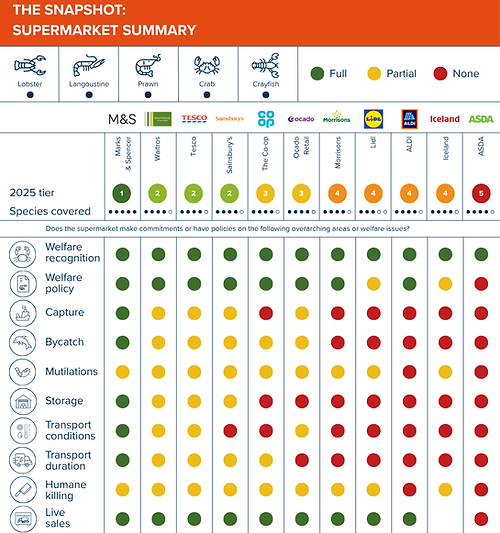
Overall, Marks & Spencer show consistent leadership across welfare policies which placed them in our top tier. Waitrose, Tesco and Sainsbury’s followed in Tier 2, with commitments or policies in most areas, although these often applied only to certain species, products or regions. This reflects a wider trend: many supermarket policies remain limited in scope, covering only farmed or wild-caught animals, only own-brand products, or only certain countries. Marks & Spencer is the only retailer with a fully comprehensive policy spanning all species, products and regions, and we urge others to extend their partial commitments to achieve the same universal coverage.
At the lower end of the ranking, ASDA was placed in Tier 5 based on the policies that were publicly available at the time of assessment. Since then, ASDA has published several policies which will be reflected in next year’s scoring. As with other supermarkets, any further published policies or commitments will be considered in future assessments.
.png)
Supermarket Scorecards
Recognition of crustacean welfare
We first looked at whether the supermarkets recognise crustacean welfare as a business issue and support that with a clear policy. While all the supermarkets assessed acknowledge that crustacean welfare is relevant, not all have turned that awareness into policy.
-
All supermarkets acknowledge welfare as a business matter.
-
Most have some form of policy, but Iceland and Lidl only partly cover the issue.
-
ASDA has no formal policy.
Bottom line: Awareness is widespread, but meaningful and complete commitments are still rare.
Reducing harm during capture and avoiding bycatch
Wild-caught crustaceans face stress and injury during capture, and poor fishing practices can also lead to harmful bycatch of other animals. Better fishing gear and handling can reduce suffering, while improved practices and equipment can also help prevent harmful bycatch.
-
Only Marks & Spencer has full commitments on humane capture and reducing bycatch.
-
Waitrose, Tesco, Sainsbury’s, The Co-op, and Ocado have some partial policies.
-
Morrisons, Lidl, ALDI, Iceland and ASDA have no commitments in these areas.
Bottom line: Marks & Spencer stands alone in taking this issue seriously; most supermarkets show only minimal or no action.
Prohibiting painful mutilations
Practices such as eyestalk ablation, claw nicking and declawing can cause severe pain and should not be used routinely. We assessed whether supermarkets prohibit these practices, except where they are carried out for essential medical reasons by trained professionals.
-
No supermarket has a full, universal ban on painful mutilations.
-
Nine retailers have limited or partial restrictions.
-
ASDA and ALDI have no relevant commitment.
Bottom line: Awareness is growing, but practical alternatives to some mutilations are still emerging, and full bans are not yet widespread.
Storage and transport conditions
Crustaceans often experience stress during transport and storage, especially if conditions are poor or travel times are long. We looked at whether supermarkets set clear standards for how these animals are held, handled and moved through the supply chain.
-
Only Marks & Spencer has policies for holding and transport conditions and limits on journey length.
-
Sainsbury’s, Tesco, Waitrose, The Co-op, and Ocado have some limited commitments.
-
Morrisons, Lidl, ALDI, Iceland, and ASDA have no stated standards at all.
Bottom line: Strong commitments are rare, and many retailers offer no transparency on storage and transport standards.
Humane stunning and slaughter
The point of killing is one of the most critical stages for crustacean welfare. We ask whether supermarkets require crustaceans to be stunned and killed humanely, using methods that prevent pain and distress. The current best practice is electrical stunning followed by manual killing before cooking. Methods like freezing, tearing apart or live boiling are considered inhumane. With the UK government stating that live boiling is not acceptable, and fuller guidance expected later this year, supermarkets should update their policies now.
-
No supermarket has a complete, universal policy requiring humane stunning and slaughter.
-
Most have partial commitments or forward-looking objectives.
-
ASDA and ALDI have no commitments at all.
Bottom line: There is movement in the right direction, but no supermarket has a fully acceptable policy yet.
Prohibiting live sales
To avoid unnecessary suffering, live crustaceans should only be handled or killed by trained professionals. They should not be sold alive for home cooking by people who are unlikely to have the skills or equipment to ensure humane treatment. Encouragingly, almost all major supermarkets now have a published policy not to sell live crustaceans to the public or untrained handlers.
-
Nine of the eleven supermarkets assessed have a full ban on live sales.
-
Iceland is marked “not applicable” because its business model does not include fresh seafood.
-
ASDA had no policy at the time of assessment but has since introduced one (to be reflected in next year’s score).
Bottom line: Most retailers now ban live sales, showing strong alignment with welfare recommendations.
A brighter light is being shone on crustacean welfare, with major UK supermarkets taking huge leaps to better their policies,
whilst others are falling short. We are proud to continue to work with them, assessing policies, supporting change,
and highlighting issues they need to improve on.
The Snapshot: Industry Benchmark on Decapod Crustacean Welfare
*This analysis is based on information from our annual benchmark reports, drawing only on publicly available sources including corporate reports and company websites. The most recent data comes from assessments carried out in September 2025 and published in The Snapshot 2025 report on 25 March 2026. Any further policy improvements made after this date will be captured in The Snapshot 2026 assessment and updated accordingly.
If you want to take a deeper dive into supermarket and seafood company policies and practices, explore our full benchmark report, The Snapshot, for the complete picture.
